
K Garira


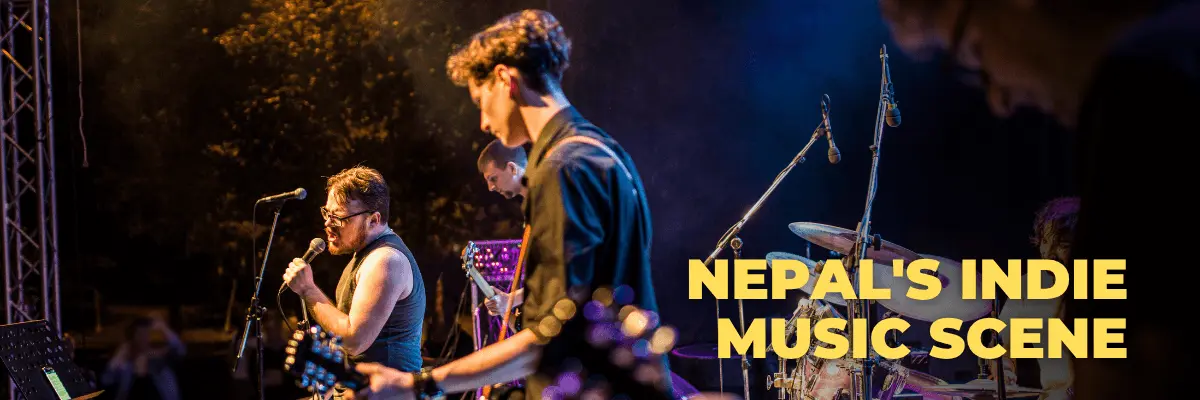
There is a particular moment at a live show in Kathmandu where something shifts. The opening act you had never heard of finishes their second song, the crowd stops talking, and everyone in the room arrives at the same quiet realisation: this is actually really good.
Nepal's independent music scene has been producing those moments with increasing frequency. What was once a tight community of bedroom producers, cover-singing college kids, and a handful of serious originals has become something considerably more interesting. Artists are releasing their own music on their own terms, building fanbases across streaming platforms and packed live rooms, and doing it without waiting for anyone's permission.
If you have been sleeping on Nepali indie, 2026 is a good time to wake up.
Quick Takeaways: Nepal's Indie Music
- Nepal's indie music scene is flourishing in 2026, driven by streaming platforms, social media, a growing live music culture, and support from the global Nepali diaspora.
- Must-listen artists include Swoopna Suman, Sajjan Raj Vaidya, Pahenlo Batti Muni, Sushant KC, Bartika Eam Rai, Wangden Sherpa, and Tribal Rain, each bringing a unique sound to the scene.
- Independent artists are thriving without major labels, building loyal fanbases through original music, direct audience engagement, and consistent live performances.
- Streaming services and platforms like Spotify, YouTube, Instagram, and TikTok have made it easier for Nepali musicians to reach audiences both within Nepal and internationally.
- Kathmandu's live music venues, including Moksh Live Restaurant & Bar, Eden Sanepa, and The Everest Hotel, have become important spaces for discovering emerging talent.
- Nepali indie music spans multiple genres, from acoustic folk and singer-songwriter music to experimental rock, indie pop, and alternative sounds.
- The Nepali diaspora has played a significant role in expanding the global reach of independent artists through streaming, concert attendance, and online engagement.
- Visitors looking to experience Nepal's music culture should attend a live show, where the energy and connection between artists and audiences showcase the strength of the country's independent music movement.
Why the Scene Has Changed So Fast
Ten years ago, getting heard as an independent artist in Nepal meant navigating limited recording infrastructure, minimal venue support, and an audience that mostly consumed music through pirated CDs and YouTube covers. The path from talented to recognised was long, expensive, and largely controlled by a handful of established labels and television singing competitions.
That calculus has shifted significantly:
- Streaming platforms changed distribution. Spotify, Apple Music, and YouTube now put independent Nepali artists on the same platform as everyone else. A song recorded in a Kathmandu apartment can reach a listener in London or Sydney the day it drops.
- The diaspora became an audience. Nepal has one of the largest diaspora populations relative to its size in Asia. Nepali workers and students across the Gulf, the UK, Australia, and Japan are hungry for music that connects them to home. Independent artists who make emotionally honest music about the Nepali experience have found a ready audience far beyond Kathmandu.
- Social media gave artists a direct line. TikTok, Instagram Reels, and YouTube Shorts mean a single clip of a well-performed original song can move faster than any radio campaign. Artists are building followings track by track, with no intermediary required.
- Live music infrastructure is growing. Venues like Moksh Live Restaurant & Bar, Eden Sanepa, and others have created regular spaces for independent acts to perform to real audiences. The event and ticketing ecosystem has grown alongside it.
The result is a generation of artists who started independently and intend to stay that way.
The Artists Worth Your Attention in 2026
Swoopna Suman
If you have spent any time around Nepali music in the last few years, Swoopna Suman's name has come up. Born in Kathmandu in 1995, he started with simple home recordings on YouTube before releasing his debut commercial single in 2014. What followed was a decade of building one of the most loyal audiences in Nepali independent music.
His sound sits in the space between folk-influenced singer-songwriter and contemporary pop. The lyrics are personal and direct, the production unhurried. His collaborations, including the 2025 release "Radha" with Abhigya Ghimire, show an artist comfortable expanding without abandoning what made people pay attention in the first place. His early tracks like "Kunai Din" and "Kasari Bhanu" remain reference points for a certain kind of emotionally direct Nepali songwriting.
Start with: "Radha", "Kunai Din"
Sajjan Raj Vaidya
Sajjan Raj Vaidya occupies a particular position in the current scene: the artist whose name younger musicians cite when explaining what kind of music they are trying to make. His releases have a consistency that is difficult to manufacture. "Mooskaan", "Suna Kaanchi", and the 2026 release "Sasto Mutu" each landed with audiences who had been waiting rather than being marketed to.
His approach leans into the lyrical end of indie songwriting, with guitar arrangements that feel considered rather than just competent. He has built a following that treats his releases as events, which is not a small thing in a streaming landscape where new music drops every Friday and most of it disappears by Tuesday.
Start with: "Sasto Mutu", "Suna Kaanchi"
Pahenlo Batti Muni
The origin story is too good not to tell. In 2015, Nepal was in the middle of a load-shedding crisis that saw daily power cuts stretching up to 16 hours. Two young musicians, Rochak Dahal and Pravesh Thapa Magar, were jamming in an apartment by candlelight because there was no other option. The band name translates to "Under the Yellow Light," and it comes directly from that room.
The band released their debut single "Bari Lai" in 2016 to immediate recognition and award nominations. A decade later, they have settled into a lineup of Rochak Dahal and Pravesh Thapa Magar on guitars and vocals, with twin brothers Lav and Kush Jung KC on drums and bass. The sound is experimental rock with progressive pop sensibilities, songs built from the band members' actual experiences rather than genre templates.
Their track "Gauthali" picked up significant streaming numbers and demonstrated what they do better than most: write music that sounds genuinely Nepali without being trapped by nostalgia or folk formula.
Start with: "Gauthali", "Lori", "Meri Ujeli"
Sushant KC
Sushant KC has spent the last several years quietly becoming one of the most reliable hitmakers in Nepali independent music, which sounds like a contradiction until you hear the output. "Behos", "Tabahi", "Estai Raicha", and the 2026 release "Jaadugari" are not experiments. They are songs built to be listened to repeatedly, with vocal performances that hold up under that kind of scrutiny.
His work rate is notable: multiple releases per year, none of them feeling rushed. He has also collaborated across the scene in ways that suggest someone interested in the broader ecosystem rather than just his own profile. The Uff release, which he recorded in both Nepali and Bengali, signals an artist thinking about reaching beyond a single-language market.
Start with: "Jaadugari", "Behos", "Tabahi"
Bartika Eam Rai
Described in some circles as the queen of Nepali indie melodies, Bartika Eam Rai builds a different kind of audience from the artists above. Her songs tend toward the introspective end of the spectrum, emotionally layered in a way that rewards close listening rather than background play. She has accumulated a global following among the Nepali diaspora that is genuinely cult-level in its engagement.
She is also one of the more prominent female voices in a scene that, as independent artists themselves have noted, skews heavily toward male collaborations. That visibility matters, and her continued output has helped create space for other women navigating the same landscape.
Start with: Her essential playlist on Spotify, which is a good introduction to the whole aesthetic.
Wangden Sherpa
For a counterpoint to the introspective end of the indie spectrum, Wangden Sherpa brings an energy that translates immediately in live settings. "Timi Nacha Na" and the 2025 collaboration "Jun Na Heri" with Sushant Ghimire showed an artist whose work functions well across contexts, in earphones on a commute and in a room full of people.
His rise has been rapid, and his listener numbers have kept growing through 2025 and into 2026. He represents the part of the indie scene that is not particularly interested in being difficult to like, and that is not a criticism. Songs that hit immediately while still being original are harder to make than they look.
Start with: "Timi Nacha Na", "Jun Na Heri" (with Sushant Ghimire)
Tribal Rain
Formed in Sikkim and operating across the broader Nepali-language music world, Tribal Rain brings an acoustic experimental quality that sits apart from the Kathmandu-centric indie sound. Their debut album "Roka Yo Samay" introduced a band interested in the stranger edges of folk and acoustic music, and their track "Bhanai" has become a reference point for listeners who want something with more texture than standard singer-songwriter fare.
They are the kind of band that builds a following slowly and keeps it permanently.
Start with: "Bhanai", "Roka Yo Samay"
What Ties All of These Artists Together
The artists above span experimental rock, acoustic folk, indie pop, and emotional singer-songwriter territory. They do not sound alike. What they share is something more structural:
- Original songwriting. These are not cover artists waiting for their moment. They are building catalogues.
- Independence. Most have built their audiences without major label infrastructure. The relationship between artist and listener is more direct than it has ever been.
- Emotional honesty. The recurring theme across Nepali indie in this period is personal experience translated into music. Nostalgia, longing, distance, home. These are songs that mean something to the people who listen to them.
- A live dimension. Almost all of these artists perform regularly. The recorded music and the live experience are two different things, and in Nepal's growing live scene, both are worth your time
Catch Them Live in Kathmandu
The fastest way to understand why this scene has momentum is to be in a room when one of these artists is performing. Venues like Moksh Live Restaurant & Bar, Eden Sanepa, and The Everest Hotel host regular events across the genre spectrum, from intimate acoustic sets to full band performances.
Kgarira makes it straightforward to find out who is playing and when, and to book tickets before the good ones sell out. Events do sell out. This is not a scene you can take for granted and always find tickets for at the door.
Browse upcoming events and book tickets at kgarira.com
FAQs
1. What is indie music in Nepal, and how is it different from mainstream Nepali pop?
Indie music in Nepal refers broadly to music made and released independently, outside the major label system, with artists retaining creative and commercial control. In practice, it covers a wide range of sounds: experimental rock, folk-influenced singer-songwriter music, ambient pop, and acoustic experimentation.
2. Where can I discover new Nepali indie music online?
Spotify playlists dedicated to Nepali indie are a genuine starting point. Following artists directly on Instagram gives you release announcements before they land anywhere else. For live events and what is happening in Kathmandu specifically, Kgarira tracks upcoming shows across venues and genres, which is useful if you want to discover artists before they are on a streaming radar.
3. Are Nepali indie artists performing internationally?
Increasingly, yes. The diaspora audience across the UK, Australia, Gulf countries, Japan, and the US creates demand for Nepali artists to perform outside Nepal, and a growing number are. The emotional connection between diaspora listeners and artists who write honestly about the Nepali experience is genuinely strong, and it has started to translate into international touring and streaming numbers that open doors.
4. How has social media changed things for independent Nepali artists?
Substantially. According to reporting on the Nepali music landscape, over 6,500 Nepali songs were released on YouTube in a single year by 2024, which illustrates both the opportunity and the challenge. Social media has removed the barriers to distribution entirely. Any artist can release music globally from a home studio in Kathmandu.
5. What is the best way to experience Nepal's indie music scene as a visitor to Kathmandu?
Go to a live show. The recorded music gives you a sense of the artists, but the live scene in Kathmandu is where you understand why this music matters to the people who love it. Venues like Moksh Live Restaurant & Bar and Eden Sanepa host regular events that span the indie spectrum.
Share this post
K Garira